


|
|
| Total Student Loans | |
|
|
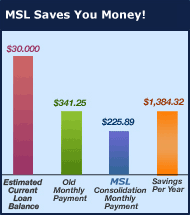
| Current Payment: | $350.49 |
| Your New Payment: | $232.59 |
| Monthly Savings: | $117.90 |
|
|
 Private & Secure Private & Secure
|
|

College Admissions Are Still Beyond the Reach of the Economically Underprivileged
 |
 |

|
|
 |
 |
||
 |
|||
|
 |
 |
|
The government-funded report, "College Access for the Working Poor: Overcoming Burdens to Succeed in Higher Education," is built upon data from the U.S. Census Bureau and other federal sources.
IHEP's findings include the following:
- Heavy work and family responsibilities prevent working poor adults from attending college full-time even when they consider education their highest priority. In 2003-2004, only 37% of working poor adults enrolled full-time, while more than 50% of non-working or poor adults with less work enrolled in full-time courses.
- The financial aid that working poor adults receive is inadequate for college costs. According to statistics from the 2003-2004 academic year, working poor adults receiving financial aid had to shell out $4,000 in personal resources to continue their education over the year.
- Patterns of part-time enrollment favored by working poor adults reduce their chances of receiving financial aid. The average grant received by 54% of working poor adults in 2003-2004 was $3,000; an average grant of $3,500 was received by 67% of non-working poor adults.
- Part-time enrollment poses a barrier to completing and performing well in academic courses. It was observed that 50% of working poor adult students left college without completing their courses or receiving credentials.
- Provide tax relief for working poor students
- Offer additional institutional support for working poor students
- Focus on supporting single parents who are working poor adult students
- Provide extra institutional support for first-generation working poor adult students
www.ihep.org/Pubs/PDF/College_Access_for_the_Working_Poor_2007_Report.pdf
|

|
|
||||||||||||||||||
 |
||||||||||||||||||||


+ Consolidate Your Private Student Loans Now! (Save Thousands!!)
Tell A Friend
 |
 |
|
The Healthcare Career Resources column is presented by HealthcareCrossing, America's leading job search site dedicated to getting jobs for healthcare professionals.
Save Money with a Private Student Loan Consolidation from Medical School Loans By Brooke Heath Even as a young child practicing medicine on your stuffed animals, you knew that you were destined to become a physician. But the road to obtaining your medical degree takes more than just the ability to mend the imaginary wounds of a teddy bear. + read more |

| CALCULATORS | |
 |
Stafford Loan Payment Calculator |
|
PLUS Loan Payment Calculator |
|
Loan Consolidation Payment Calculator |